
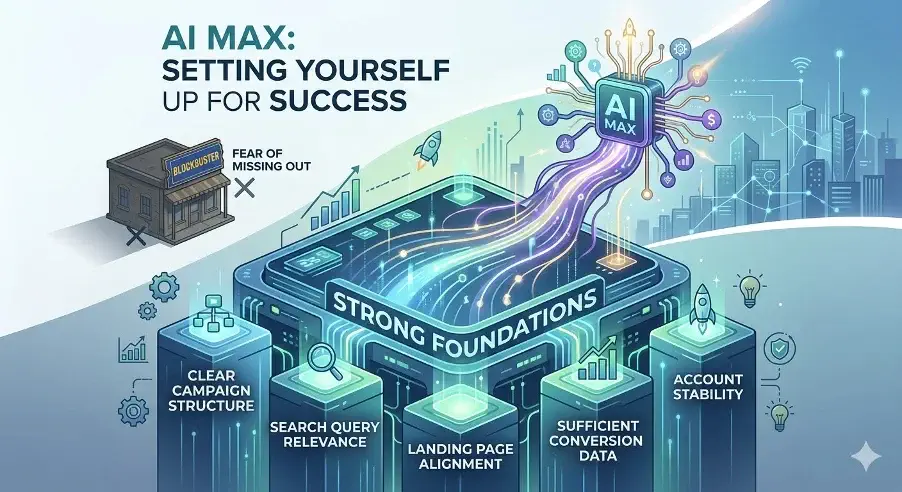
AI has rapidly become a buzzword, not just within performance marketing, but across wider business conversations. Whether you’re leading operations or managing campaigns day to day, there’s an increasing sense of urgency, with many thinking “we need to adopt AI or risk falling behind”.
To be honest, fear of being left behind is valid. If Blockbuster had shifted online, who knows, it might have been Blockbuster and chill. But this fear has also created a risky mindset, where people rush into AI without the right foundations in place. In Google Ads, this is particularly evident in what we see when auditing accounts. AI Max is sometimes enabled in the hope of unlocking quick wins, but without a clear understanding of what it actually needs to succeed. The result is that AI can become a barrier rather than a benefit. When driven by fear of missing out rather than informed decision making, it can lead to inefficient spend, irrelevant traffic, and ultimately the misconception that the tool itself won’t work.
AI is a powerful tool, but only when implemented correctly. Without the right structure, data, and stability, solutions like AI Max can just as easily harm performance as enhance it.
Stuck at wondering how AI Max works? More Info Here
Start with Strong Foundations
Before introducing AI-driven solutions like AI Max, your account structure needs to be in a strong, stable place. AI is only as effective as the signals it receives, and if those signals are unclear or inconsistent, performance will suffer. This is something also highlighted by Ginny Marvin, Product Liaison at Google, reinforcing the importance of getting the fundamentals right before leaning into automation.
- Clear Campaign Structure
Your campaigns and ad groups should be logically organised, with clearly themed keyword groupings. This gives AI Max a clear understanding of intent and helps it match users to the most relevant ads. If your structure is disjointed or overly broad, the algorithm has to work harder to interpret intent, often leading to weaker results. - Search Query Relevance
One of the most important signals for AI Max is how search queries map to your ad groups. If queries are being funnelled into the wrong areas of the account, AI won’t correct this for you. Instead, it will scale those inefficiencies. Ensuring strong query-to-ad group alignment is essential before introducing more automation. - Landing Page Alignment
AI Max doesn’t rely solely on keywords. It also uses landing page content to better understand context and relevance. If your landing pages don’t closely match the intent of your ad groups, you dilute the signals AI depends on. Strong alignment between keywords, ads, and landing pages creates a clearer pathway for both users and the algorithm, ultimately driving better performance.
Stability Matters More Than You Think
AI thrives on consistency. Frequent or aggressive changes can confuse the algorithm, making it harder to learn and ultimately leading to inefficient performance.
This is something we often uncover during audits. In one example:
- Budgets were increased by over 50%
- tCPA was raised from £50 to £150
- AI Max was introduced at the same time
The outcome was predictable:
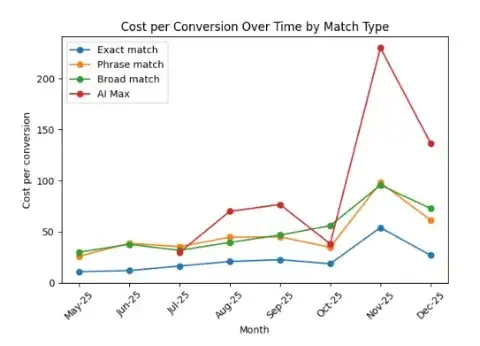
- CPCs rose significantly
- Conversion rates declined
- Overall efficiency dropped
It’s easy to look at this and assume AI Max doesn’t work. But that’s not the reality.
What actually happened is much simpler. The algorithm was given new signals: spend more and accept a higher cost per conversion. Naturally, it followed those instructions.
AI doesn’t make arbitrary decisions. It responds directly to the inputs you give it. When those inputs change drastically, performance will reflect that.
When Is the Right Time to Use AI Max?
AI Max isn’t a starting point; it’s a scaling tool. Introducing it too early can limit its effectiveness, but used at the right time, it can unlock meaningful growth.
So when are you actually ready?
You’re Limited by Search Volume
If your current match types are no longer delivering incremental growth, it’s a strong signal you’re hitting a ceiling. AI Max is designed to expand reach and capture additional demand beyond what you’re currently accessing.
You’ve Tested Broad Match
Broad match plays an important role in building the signals AI Max depends on. The more coverage and data you’ve generated through broad match, the stronger the foundation for AI Max to perform effectively.
You Have Sufficient Conversion Data
AI needs volume to learn. If your campaigns aren’t generating consistent conversion data, AI Max will struggle to identify what success looks like. Strong, reliable data is essential for it to optimise with confidence.
You Have the Capacity to Monitor Closely
AI Max is not a set and forget solution, especially during the early stages. It requires active oversight to ensure it’s working as intended. This includes regularly reviewing:
- Search term reports
- Automatically generated ad copy
- Landing pages being used
Without this level of monitoring, inefficiencies can quickly creep in and scale before they’re noticed.
Conclusion
AI in performance marketing isn’t a magic switch for better results. It’s a tool that amplifies what’s already there. If your foundations are strong, AI can unlock growth and efficiency. If they’re not, it will simply scale the problems.
So before adopting AI Max, ask yourself:
- Is my account structured properly?
- Do I have stable, consistent signals?
- Am I truly ready to scale?
Because in performance marketing, success with AI isn’t about moving faster.
It’s about building smarter. Want to learn more about paid media? Explore our other blogs or get in touch.