
Local campaigns sound simple in theory. Pick a location, add in some keywords around “near me”, and let the traffic roll in…
If that sounds like you, then you are definitely in the right place.
In reality, they need a lot more thought than this. Local search behaviour is different to what you would see across a national scale, and the metrics you look at to measure success should follow suit.
At a local level, people will not always convert online, they might search & compare options but then actually walk into a shop, restaurant or venue without ever “converting online” which makes attribution a tricky thing to navigate.
Because of this, you need to look at more than just the “book or buy now” conversion actions in platform. Here’s how we usually approach campaigns at a local level.
What campaign types are right to use?
Local campaigns perform best when you use a variety of different campaign types as they can play different roles in the funnel and drive different local actions. We would look to focus on a mix of Search & PMAX, and if budget allows, also Demand Gen, with each playing a different role:
| Campaign Type | Role In Local Strategy |
|---|---|
| Search | Capture high-intent demand and drive bookings |
| PMAX | Capture Maps traffic, footfall and last-minute appetite |
| Demand Gen | Build awareness and create demand in specific areas |
Search: Capture Hight Intent Bookings or Sales
Your search campaign will be utilised to capture users who already know what they want and need, actively searching for the best nearby:
Your keyword strategy should be focused through a mix of generic keywords and locations based keywords, such as:
– Service + Location (pub in Farringdon)
– Service + Near Me (pub near me)
– Generic (pubs with beer gardens)
From hospitality to leisure brands, this will be your biggest driver of direct bookings and reservations & your goal should be to maximise this through Max Conversions or Max Conversion Value, if you are feeding through revenue data.
PMAX: Capture Footfall & Last-Min Demand
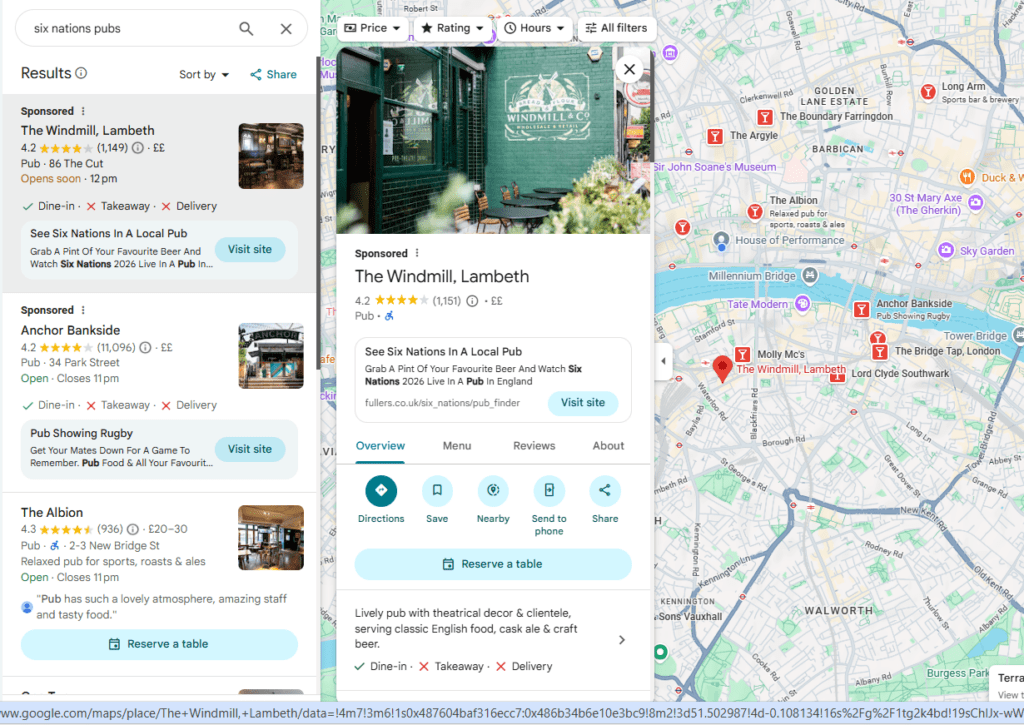
At HOP, we love using PMAX for local discovery across Google Maps placements. People often search for venues directly in Maps when they are already out and about, with PMAX, we have found it the best campaign type to ensure you have good coverage across this placement.
Where Search captures clear intent, PMAX helps capture more spontaneous and last minute demand for services.
How To Appear On Maps
To appear on Maps, businesses need to have location assets set up in Google ads which are imported through your Google Business Profile. Without this, Google will have no way of linking ads to physical locations! Heres how they could look
Optimising For Footfall & Physical Visits
To capture this local demand, we would suggest using different optimisation goals compared to your Search campaign which drives bookings.
Instead of focusing purely on enquiries or booking revenue, you can optimise to signals which indicate real world intent. Local Directions and Store Visits are our favourites:
| Optimisation Goal | What Is Measures | Why It Matters |
|---|---|---|
| Local Directions | When a user clicks to get directions to a business via Google Maps or location assets. | A strong signal of real world intent. If someone is asking for directions, there’s a high chance they’re planning to visit the location. |
| Store Visits | Google’s estimated metric for when users visit a physical location after interacting with an ad. | Helps connect paid media activity with real world footfall. Particularly useful for hospitality, retail and multi-location businesses where conversions don’t always happen online. |
Demand Gen : Driving Local Awareness
While Search & PMAX are used to capture existing demand, Demang Gen should be used to drive local awareness in specific areas.
This can be incredibly useful when a brand wants to:
- Promote new locations
- Highlight seasonal offerings
- Promotional awareness
- Drive awareness of locations in specific cities or boroughs
Demand gen can be great as location targeting can be structured at ad group level, allowing you to tailor messaging to specific audiences & locations, while keeping the data consolidated into one campaign.
For more detail on demand gen, feel free to reach out to get access to our guide and webinar recording.
Our Final Thoughts
Local campaigns in google ads work best when they reflect how people actually make decisions.
Someone might see a video, search for the venue later, check directions on Maps, then turn up without ever booking online. Google Ads doesn’t always get the perfect credit for that journey.
Because of this, a strong local strategy shouldn’t just rely on one campaign type, but use a mix so you can diversify across Google’s ecosystem to meet customers on those different journeys.
When the campaigns are structured in the right way around how people actually discover and search for places locally, Google ads can be a real driver for bookings and real world interactions at a local level.
I hope you found this useful, but if you have any questions do reach out to us